
Team Cloobot
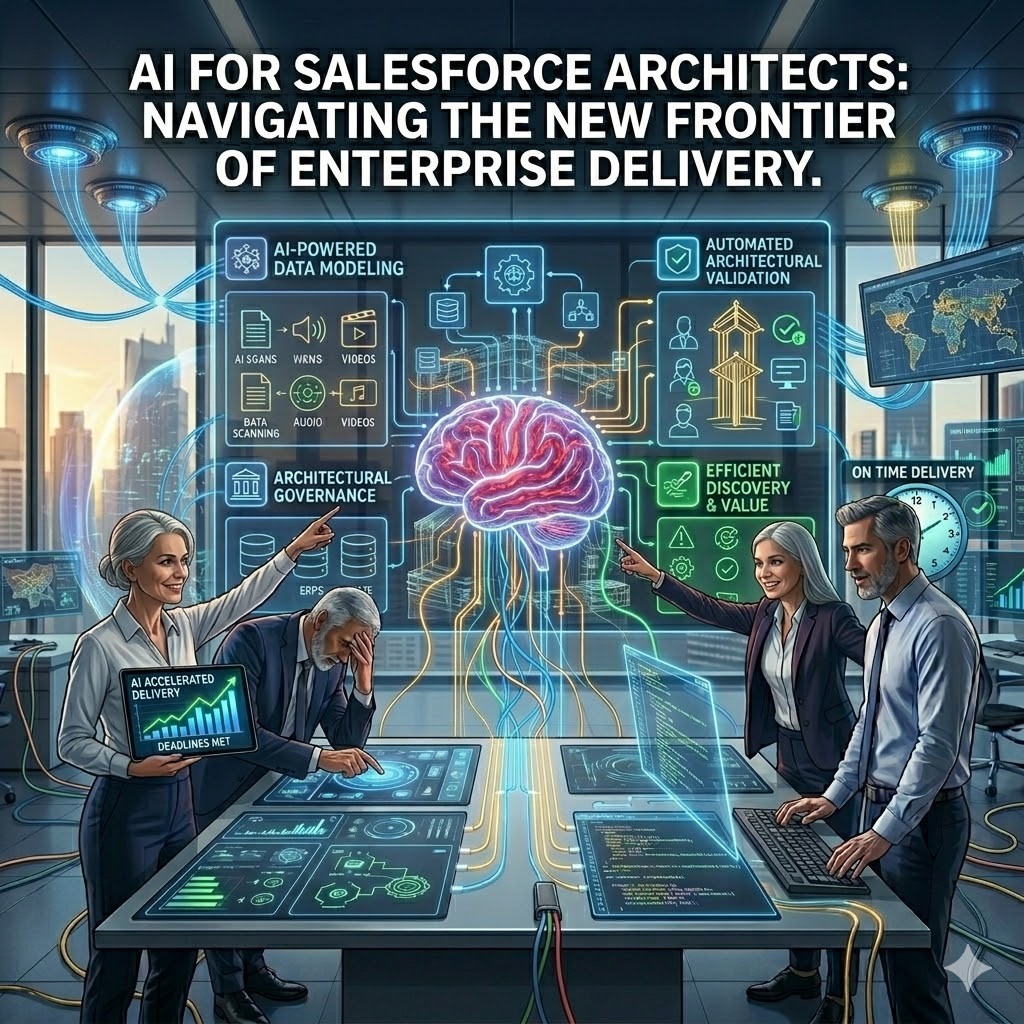
In today’s enterprise landscape, the role of Salesforce architects is evolving faster than ever. Managing increasingly complex orgs with hundreds of thousands of configurations, integrations, and customization layers requires more than traditional expertise. As organizations push for faster innovation cycles, reducing delivery times while maintaining stability and compliance becomes a formidable challenge.
Enter GenAI, a transformative force reshaping the way architects approach their work. Far from being a mere trend, GenAI is now a strategic enabler that helps architects unlock insights, automate tedious tasks, and accelerate delivery while safeguarding platform integrity.
The Data-Driven Transformation of Salesforce Architecture
Large-scale Salesforce orgs are growing in complexity at an astonishing pace. The average Salesforce deployment in enterprise environments involves over 1,000 custom objects and 10,000 custom fields. For organizations with sprawling, multi-department ecosystems, these figures climb exponentially, making manual analysis and management nearly impossible.
Meanwhile, the risks of unmanaged complexity are clear. A report from Gartner indicates that nearly 70% of large Salesforce projects face delays or scope creep due to configuration and technical debt issues. These delays translate into substantial costs, which estimates show that enterprise Salesforce implementations often exceed budget by up to 40%, with average costs ranging from $10,000 to over $200,000 depending on scope.
Furthermore, organizations report that technical debt accounts for approximately 20-25% of the cost overruns in Salesforce projects. Without proactive management, this debt can result in system instability, data inconsistencies, and difficulty scaling operations.
The Power of AI: Turning Data Into Action
AI’s integration into Salesforce architecture addresses these pain points directly. It can analyze vast quantities of metadata, dependency relationships, and configuration patterns instantly. As a result, architects gain precise, actionable insights that help them plan, optimize, and secure their orgs.
AI-driven platforms like CloobotX use org metadata to:
Map dependencies across objects, fields, and integrations in real time, reducing manual effort
Detect redundant configurations and legacy code, minimizing technical debt, which significantly contributes to project delays
Generate modular, build-ready requirements that reduce development cycles
Moreover, AI-enabled impact analysis allows architects to simulate changes before deployment. This proactive risk assessment can reduce rollout failures by around 40%, preventing costly fixes post-launch.
Practical AI Use Cases in Enterprise Salesforce Environments
The tangible benefits of AI are evident across multiple use cases:
1. Continuous Org Health Monitoring: AI platforms continuously scan and score org health, alerting teams to potential issues before they escalate, with organizations seeing a 15-20% reduction in major system outages.
2. Automated Documentation and Requirements: Generating documentation for complex orgs can take weeks. AI automates this process, often reducing documentation time by 60-70% and improving accuracy.
3. Impact and Risk Predictions: Before making configuration changes, AI predicts potential fallout, saving organizations thousands in rework and downtime.
Shaping the Role of Salesforce Architects with AI
The adoption of AI transforms architects from manual troubleshooters into strategic decision-makers. Recent surveys reveal that 88.9% of Salesforce architects now consider AI a crucial part of their architectural toolkit.
This shift requires new skills:
AI Literacy: Understanding how AI works, its strengths, and limitations.
Data-Driven Decision Making: Using AI insights to prioritize tasks and design more resilient architectures.
Governance & Ethics: Ensuring AI use aligns with enterprise policies and regulatory standards.
In this domain, architects become AI stewards, guiding the responsible integration of automation while ensuring platform stability and compliance.
The Future of Enterprise Salesforce
While AI powers automation and intelligence, the foundational SaaS platform remains critical. Salesforce’s mature, certified cloud infrastructure guarantees security, compliance, and support elements that no AI application can replace.
Together, AI and SaaS form a resilient architecture ecosystem where AI augments the platform’s capabilities, enabling rapid, intelligent deployment without risking stability or regulatory oversight.
Leading organizations now envision this symbiosis as a strategic advantage driving innovation while safeguarding enterprise trust and operational resilience.
Final Words
AI is no longer just an experimental add-on but a core enabler of enterprise Salesforce success in 2025. It empowers architects to see further, act faster, and mitigate risks more effectively, which turns sprawling and complex orgs into well-oiled, intelligent platforms.
By embracing AI, architects can elevate their role from tactical operators to visionary leaders driving scalable, secure, and innovative Salesforce solutions that meet today’s demanding business needs.
The future belongs to those who harness AI’s potential responsibly and strategically ensuring that enterprise Salesforce environments are not just faster but smarter, safer, and truly future-ready.